


Power Rack Buying Guide: Sizes, Features, and Safety
Thinking about a power rack? Here's how to choose the right size, the features that matter, and how to set one up safely at home.
Why Your Garage Needs a Power Rack (and Why Your Back Will Thank You)
Picture this. It's 6am, the house is quiet, and you're standing under a loaded barbell with nobody around to spot you. A bad rep could go one of two ways: you power through, or you end up pinned under 100kg with your dignity on the floor.
That's the whole reason a power rack exists. It's a steel cage that catches the bar if you can't get it back up. Once you've trained inside one, you'll wonder how you ever squatted without it.
I'll be honest: the first time I bought a rack, I picked it based on how it looked in the photo. Big mistake. The ceiling was too low, the footprint ate half the garage, and the safety pins were in the wrong place. So this guide is the one I wish I'd read first. We'll cover what a power rack is, how to pick the right size, the features worth paying for, and how to set one up so it keeps you safe.
So, What Is a Power Rack?
A power rack is a four-post steel frame. The uprights sit at each corner, and you adjust the J-hooks (the brackets that hold the barbell) and safety pins or straps to suit your height and lift.

You'll use it for:
- Back squats and front squats
- Bench presses
- Overhead presses
- Rack pulls
- Pull-ups, when the rack has a pull-up bar or supports an attachment
Because the safety pins sit at the height you set, a missed rep lands on steel rather than your chest or neck. That's the difference between a rack and a bench in the corner.
Quick question: does a power rack need a spotter? Not if it's set up properly. Set the pins just below your sticking point and you can train heavy on your own.
Power Rack vs Squat Rack: What's the Difference?
People mix these two up constantly, and honestly, the names don't help. Here's the simple version.
| Feature | Power Rack | Squat Rack |
|---|---|---|
| Uprights | Usually four | Often two, or a more open frame |
| Safety bars or pins | Yes, on multiple sides | Varies, often fewer |
| Solo heavy lifting | Generally safer | Possible, but less forgiving |
| Footprint | Larger | Smaller and more open |
| Best for | Serious strength training, solo lifters | Tight spaces, lighter setups |
A squat rack is a fine choice if you're short on room and mostly lift lighter. But if you plan to push heavy squats or bench alone, a power rack gives you the margin you want. Think of it like a bike helmet with a visor. Both protect your head, but one covers more of the situation you're actually in.
Sizes: Getting the Footprint and Height Right
This is where most people get caught out. Before you click "buy", measure three things.

1. Floor footprint. Measure the width and depth of the rack, then add room on every side. You need space to load plates, step up to the bar, and move around the rack without clipping a wall. A rack that fits exactly is a rack you'll hate using.
2. Ceiling height. Measure from the floor to the ceiling, then compare it with the rack's listed height. Pull-ups and overhead presses are where you'll feel a low ceiling first, so leave some headroom above the top of the rack.
3. Bar length and plate size. A standard Olympic barbell is around 2.2m long, and bumper plates are roughly 450mm across. Make sure the space can handle both, plus a bench if you're adding one.
| What to Measure | Why It Matters | Tip |
|---|---|---|
| Width and depth | Plates, bench, and movement space | Add 60 to 80cm of clearance where you can |
| Ceiling height | Pull-ups and overhead presses | Check the rack's stated height, then add headroom |
| Bar and plate clearance | Loading and unloading safely | Measure a real bar if you have one |
| Floor type | Stability and noise | Rubber mats protect concrete and reduce noise |
I once watched a mate buy a rack for a garage with a roller door, then realise the door track sat right where the rack needed to go. Measure twice. Then measure again, because the second time you'll notice the light switch.
Features That Actually Matter
Brochures love to list every feature under the sun. Most of them don't change your training. These do.

- Adjustable J-hooks: They should sit at a height that lets you unrack the bar without shuffling your feet.
- Safety pins or straps: Check they're easy to adjust and sit securely. Set them just below the bottom of your squat or bench.
- Pull-up bar: Make sure it's at a comfortable height and has enough headroom for your chin to clear it.
- Attachment compatibility: If you think you'll add a landmine, lat pulley, or dip bar later, check the rack supports them. It's a lot cheaper to plan now than to rebuy.
- Steel quality and construction: Look for solid, heavy-gauge steel and clean, consistent welds. Check the manufacturer's stated load ratings for the rack, the J-hooks, and the pull-up bar.
- Stable footing: A wide base with flat, level feet keeps the rack from rocking under load.
A quick checklist for shopping:
- Does it fit my space with room to load plates?
- Can I clear the ceiling for pull-ups?
- Are the J-hooks and safety pins easy to adjust?
- Does it take the attachments I might want later?
- Are the rated loads clearly stated?
- Do I need to bolt it down, and do I have the means to do so?
Power Rack Safety: The Non-Negotiables
Here's the part I'd rather you read twice. A rack is a safety tool, but only if you use it like one.
- Set the safety pins before you load the bar. For squats and bench presses, put them just below the lowest point you'll reach.
- Use collars every time. Plates that slide off one side make the bar tip, and that's how people get hurt.
- Load evenly. Put the same weight on each side, and check it before you start the set.
- Start light and build up. Warm up with the empty bar, then add weight in steps. Nobody's proving anything on rep one.
- Check the bolts and feet regularly. A rack that's been moved, dragged, or slammed can work loose over time.
- Bolt it down if you're training heavy. Bolt-down racks are generally more stable. Freestanding racks can work well with a wide, level base, but always stay within the rated limits.
- Keep the area clear. Mats around the rack help with noise, floor protection, and footing.
What Else Goes in the Space?
A rack on its own is a good start. A rack with a few sensible extras turns it into a proper gym.

- Bench: Essential for bench presses, step-ups, and seated work. An adjustable bench gives you incline and decline options.
- Barbell and plates: A 20kg Olympic barbell with collars covers most rack work. Bumper plates are handy because they can be dropped safely.
- Flooring: Rubber mats protect the floor and make a lifting area feel less like a garage.
- Attachments: Landmines, lat pulleys, and dip bars widen what you can train without buying another machine.
Some BRIXX Power Racks to Look At
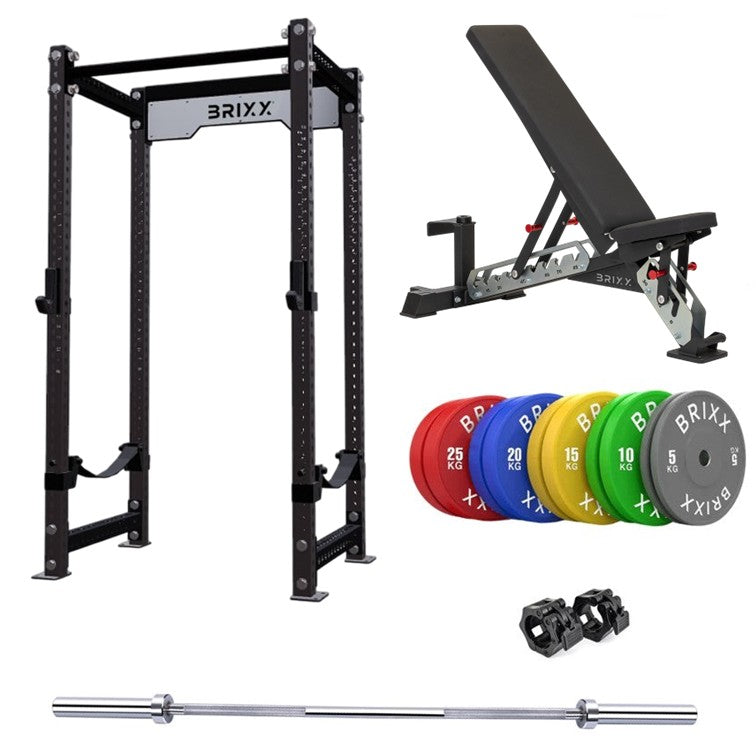
If you'd like to see how these pieces fit together, BRIXX Fitness sells several power racks, some on their own and some in bundles with a bench, plates and a barbell. Here's a selection at regular price.
| Product | Regular Price | Link |
|---|---|---|
| BRIXX Zeus 2000 Power Rack | $650 | View |
| BRIXX Zeus 3000 Power Rack | $875 | View |
| BRIXX Zeus 5000 Power Rack | $1,275 | View |
| BRIXX Mammoth 5000 Power Rack | $3,950 | View |
| BRIXX Apollo Power Rack | $1,700 | View |
| BRIXX Zeus 2000 Power Rack, Bench, Plates & Barbell Package | $1,650 | View |
| BRIXX Zeus 5000 Power Rack, Bench, Plates & Barbell Package | $2,125 | View |
The Zeus 2000 package is the entry point for a bundled setup. The Zeus 5000 package includes a commercial bench, a 20kg 2.2m barbell, collars and bumper plates, and the Zeus 5000 rack comes with lat pulldown and low-row, landmine and dip attachments. The Zeus range is rated to 325kg and has a pull-up bar that flips to lower the height. Check each listing for the exact contents before you buy.
Power Rack Exercises (So You Know What You're Buying For)
Most people buy a rack for squats, but it can do a lot more.
- Back squats and front squats: The bread and butter. Set the pins low and go to depth.
- Bench presses: Pair the rack with a bench, set the pins at chest height, and you're covered.
- Overhead presses: A standing press in the rack feels stable and lets you push hard.
- Rack pulls: Start the bar at knee height or just above to build pulling strength.
- Pull-ups: Works if the rack has a bar or a compatible attachment and you have the headroom.
- Rows and accessories: Add a landmine or cable attachment and you've got rows, presses, and rotational work.
Want more out of your sessions without crowding your floor? A rack paired with the right attachments covers most of what you need.
Final Thoughts: Buy the Rack That Fits Your Space and Your Lifts
A power rack is one of the best investments you can make in your training. It lets you lift heavy with confidence, train alone without fear, and build a setup that grows with you.
Here’s the short version. Measure your space before anything else. Choose a rack with pins and J-hooks that adjust easily. Check the rated loads. Set it up properly every time. And think about the extras now, so you don’t have to rebuild the layout later.
So, what’s your space like? Is it a spare room, a double garage, or a corner of the backyard shed? Tell me in the comments and I’ll help you work out which setup fits. Then go grab a barbell and get under it.
Frequently Asked Questions
What is a power rack?
A power rack is a four-post steel frame for barbell training. It has adjustable J-hooks and safety pins or straps, so you can squat, bench and press without a spotter.
Is a power rack the same as a squat rack?
Not quite. A power rack usually has four uprights and safety bars on multiple sides. A squat rack is often more open, with fewer uprights and fewer safety features.
Is a power rack safe to use alone?
Yes, when it’s set up correctly. Set the pins just below your sticking point, use collars, and never load more than you can control.
What exercises can I do with a power rack?
Back squats, front squats, bench presses, overhead presses, rack pulls, pull-ups, rows, and accessory work with attachments.
Do I need a bench with a power rack?
For bench presses, seated overhead presses and many accessories, yes. An adjustable bench gives you the most variety.
How much space does a power rack need?
Measure the width, depth and height of the rack, then add clearance for the bar, plates and bench. Ceiling height matters most for pull-ups and overhead work.
How much weight can a power rack hold?
It depends on the steel, the design and the hardware. Always check the manufacturer’s rated loads for the rack, J-hooks, safety bars and pull-up bar before you buy.
What is the difference between a power rack and a power cage?
People use the terms interchangeably. “Power cage” is sometimes used for models with a more enclosed frame.
Do I need to bolt a power rack to the floor?
Bolt-down racks are generally more stable for heavy lifting. Freestanding racks can work well if they have a wide, level base and you stay within their rated limits.
Can I do pull-ups on a power rack?
Many racks include a pull-up bar or support an attachment. Check the pull-up capacity and make sure you have enough headroom.
What accessories are worth buying for a power rack?
Dip bars, landmine attachments, lat pulleys, low-row systems, plate holders, barbell holders and safety straps are all useful. Pick the ones that match what you actually want to train.
Shop the gear in this post
 BRIXX Zeus 2000 Power Rack
$575.00
View product
 BRIXX Zeus 3000 Power Rack
$775.00
View product
 BRIXX Zeus 5000 Power Rack
$1,075.00
View product